





Cambodia: Rural Communities Take
Charge of Children's Education
|
"Authorities,
communities, and
teachers now work
together to improve
education. Together
we identify out-of-school
children and help
them to find ways
to go back to school.
The support has really
helped my commune
and we are proud
of the positive changes
we made."
- Houl Seourn, chief
of the Commune Council
of Boeung Char
|
|
World
Education and its partners
serve over 60,000 children
in 165 schools in 3 provinces.
Scholarships have been provided
to over 6,000 primary and
secondary school students.
|
In the remote regions of Cambodia, some
of the country's poorest communities
have limited access to schools, teachers,
or educational support. Although the
right to a basic education for every
child is guaranteed in the Cambodian
constitution, children in remote areas
have not had access to government services.
There are only a few complete school
buildings in these areas, and it is difficult
to recruit teachers to villages with
poor living and working conditions. Few
families can afford to purchase educational
supplies and uniforms and parents often
prefer to keep children, especially girls,
at home to contribute to household income.
These issues particularly hurt children
who are left at the margins of Cambodian
society—those who are from ethnic
minority groups, impoverished, affected
by HIV and AIDS, or disabled.
The children of Chour Krang, a village
in the northeast province of Kratie,
were affected by many of these issues.
Before World Education began implementing
the Education Support to Children in
Under-served Populations (ESCUP) Project
with its local partners, children from
the Steang minority group had to walk
almost three miles a day through dense
bush and forest to reach their school.
The youngest were often kept at home
because of the distance, delaying their
education.
The children of Beoung Char, an island
located in the Mekong River along the
border of Kratie Province, faced a similar
problem. Families were spread out over
the 12-mile island, which lacked proper
roads and infrastructure. According to
Houl Seourn, chief of the Commune Council
of Boeung Char, "many of the children
lived too far away from the three schools
on the island, and villagers were concerned
about the limited education opportunities
for their children."
Through ESCUP, part of the EQUIP1 partnership
led by American Institutes for Research,
World Education and its partners work
with underserved communities to improve
access to education. In Kratie Province,
World Education and its partners consulted
with school committees, village leaders,
and parents in communities like Chour
Krang and Beoung Char, to identify the
different obstacles to education. With
ESCUP support, community members worked
together to devise solutions and take
action. In Chour Krang, community members
chose to build a temporary school building
closer to the village. ESCUP provided
the funds for materials, while community
members provided labor.
|
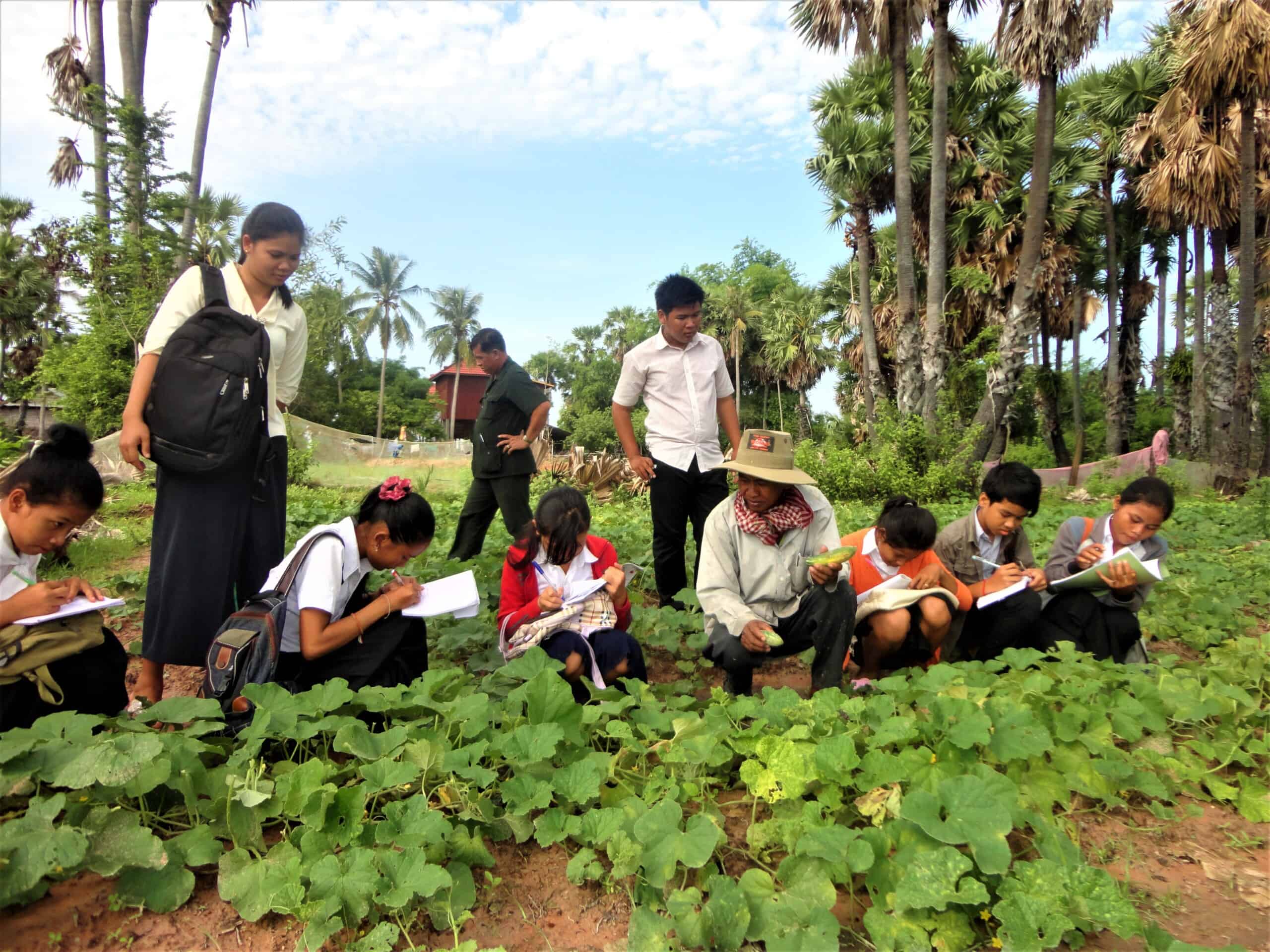
Children
from Chour Krang stand outside
their new school building
during construction.
|
By working together, the community is
now more involved and engaged in keeping
children in school. Today, more than
113 children are now attending the school
and children are able to enroll at age
six, instead of waiting until they can
manage the long walk to school. Non Phorn,
the deputy village chief of Chour Krang,
noted that even though there are limited
resources in the village, he is "glad
that the local people made contributing
labor to the new village school a priority
because education is a precious thing
for all the children in the village."
In Beoung Char, the community came together
to construct several small schools in
areas far from the government schools.
However, the community could not afford
to hire teachers and it was difficult
to recruit trained teachers to work in
their remote area. After consultation,
ESCUP worked with the community to identify
local community members and train them
as teachers. Houl Seourn describes the
benefits of training local teachers: "this
has improved the education services tremendously,
especially because the teachers come
from our own community and understand
the children and their situations well.
The support from ESCUP facilitated better
collaboration between the communities,
schools, and the Ministry of Education,
Youth and Sports (MoEYS), and strengthened
the role of the community in education."
More
Features Stories...
|